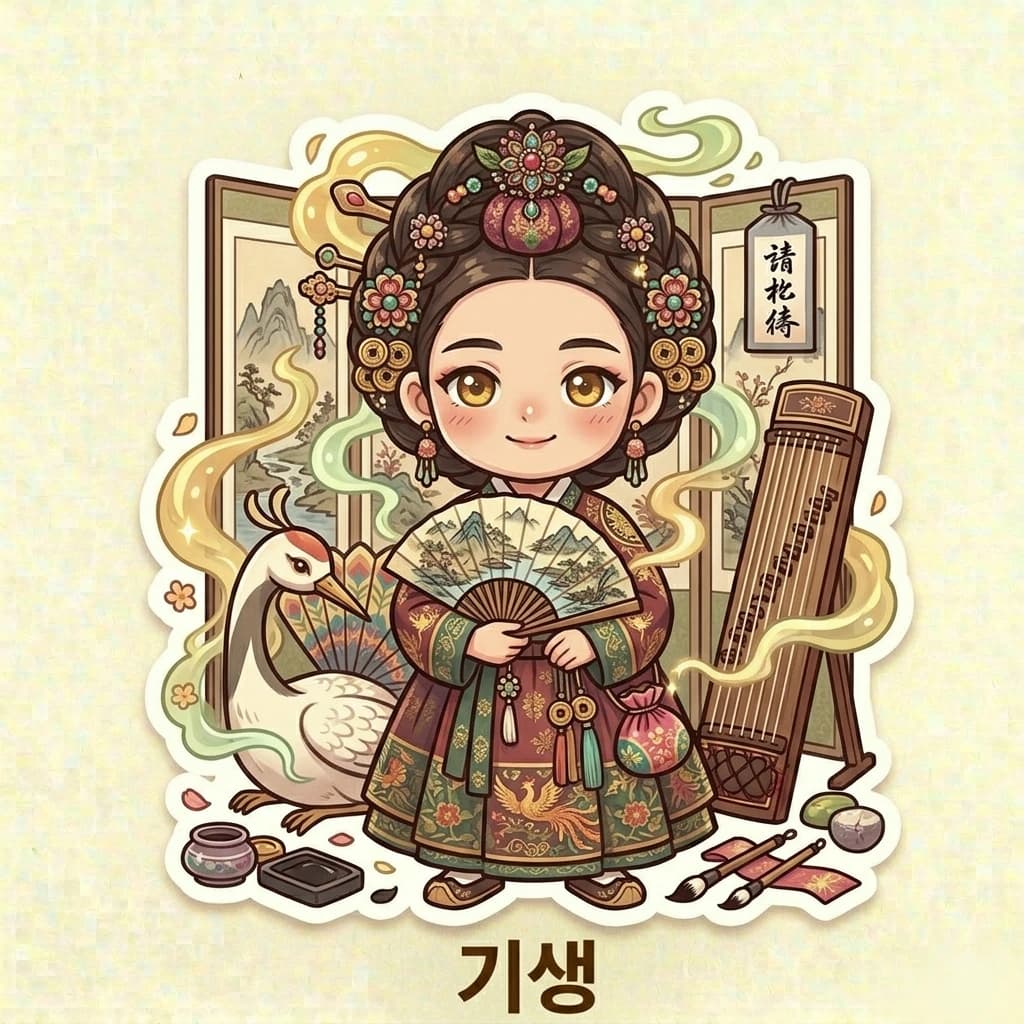
Past Life Story
In the twenty-fifth year of King Jungjong, you were born into a low-born family. Your mother was a registered courtesan, and you would never come to know who your father was. Upon your mother's lap, you grew up listening to the sound of the geomungo. Your first lullaby was a sijo poem. By five you had learned the geomungo. By seven you had memorized poetry. Your mother taught you, "Even as a gisaeng, you must know letters and know poetry. Only then can you sit at an equal table with yangban and pour their wine." From your earliest days you knew the weight of those words. In your thirteenth year, you were formally registered. Your beauty and skill soon became known throughout Hanyang. Yangban sought you out, and you were called to their drinking parties. Yet you were not merely a woman who poured wine. Your poetry could match that of renowned men of letters, and your geomungo shook the hearts of those who listened. In your seventeenth year, you met the son of a noble house. He loved you, and you loved him. But his clan would not permit it. You wept once, deeply, and after that you wept no more. That day you understood. The love of a gisaeng belongs to no one. It belongs only to that moment. At twenty you dreamed of the freedom of Hwang Jini. You became no one's concubine, were tied to no one. Yangban or king's minister—before you, all were simply men. Through poetry, through song, through dance, you met them as equals. That was your weapon and your freedom. In your twenty-fifth year, you took part in a great poetry gathering. The renowned men of letters of Hanyang had gathered. There you recited a poem. "My heart belongs to none. Like the wind, like the flowing river." A great scholar at that gathering copied your poem to take with him. That poem was later included in a collection, and your name remained as the name of a poet as well. Around thirty, you met an old yangban. He was a man of neither wealth nor power, only one who loved poetry. With him you exchanged poems and felt a deep kinship. Yet you did not become his concubine. You remained friends. Once a month you would meet, exchange poems, drink tea, and part. That was your deepest relationship. In your thirty-second year, you fell ill. Tuberculosis. In that age, it was a death sentence. You drank medicine and endured. But you knew. There was not much time. In the spring of your thirty-third year, you held a final poetry gathering. To your small room you called only those closest to you. The old yangban came as well. You played the geomungo once more, recited a poem once more. That night, you made one request. "When I die, do not bury me beside any yangban's tomb. I belonged to no one. Even in death I shall not lie beside anyone." That was your last request. At dawn the next day, you departed quietly. Your last sound was a single note of the geomungo. The lowest and deepest tone. Your poems were later collected, and your name remained as the name of a free woman. You were born of low birth, yet you were freer than anyone. Your soul, even now, is bound to nothing, flowing somewhere—like the wind, like the running river.